



As artificial intelligence (AI) rapidly becomes part of everyday life and continues to transform work, the question of what constitutes “21st-century skills” has become increasingly important in education worldwide. The term refers to a broad set of competencies identified by ATC21s (Assessment and Teaching of 21st Century Skills), an international research project launched in 2009, as essential for navigating the challenges and opportunities of contemporary society.
Critical thinking, communication, creativity, and information literacy are among the core competencies included in this framework. Unlike academic achievement or the amount of knowledge a student has acquired, these skills are capabilities children can draw on throughout their lives.
This article provides a structured overview of what 21st-century skills are, why they have attracted so much attention, how they relate to education in Japan, and how to develop them in international school settings.
21st-century skills encompass a broad range of competencies that extend beyond traditional academic knowledge and achievement, including the ability to think critically, create, communicate, and collaborate with others. These competencies have increasingly been incorporated into educational policies and school practices worldwide. This section examines how 21st-century skills are defined, the context in which the concept emerged, and the major frameworks associated with it.
21st-century skills refer collectively to the competencies needed across work, civic life, and learning in a society increasingly shaped by digitalization, globalization, and automation. They include critical thinking and problem-solving, metacognition, communication, collaboration, creativity and innovation, information literacy, ICT literacy, citizenship, life and career skills, and personal and social responsibility.
At the heart of 21st-century skills is a fundamental shift from an educational emphasis on accurately acquiring knowledge and technical competencies to an emphasis on applying knowledge, exercising judgment, collaborating with others, and creating value. Rather than simply learning how to arrive quickly at a predetermined correct answer, children increasingly need the ability to engage with questions that may have no single correct answer, exchange ideas with others, and work toward the best possible solution.
One major initiative that brought 21st-century skills to international attention was ATC21s, an international research project launched in 2009. Six countries—Australia, Finland, Portugal, Singapore, the United Kingdom, and the United States—participated in the project, with financial support from Cisco, Intel, and Microsoft. Leading researchers worked together to develop a framework to define and assess 21st-century skills.
A major contribution of the project was its use of the KSAVE model—Knowledge, Skills, Attitudes, Values, and Ethics—to describe these competencies in concrete and assessable terms. By giving clearer structure and dimensions for assessing concepts such as “communication” and “creativity,” the project made the framework more applicable to schools and educational institutions worldwide.
Another internationally recognized framework is the “4Cs” promoted through P21 (Partnership for 21st Century Learning) in the United States. The four Cs stand for Critical Thinking, Communication, Collaboration, and Creativity. By organizing essential 21st-century competencies into four clear, memorable concepts, the framework has become widely recognized in educational settings worldwide.
Although the ten skills identified by ATC21s and P21’s 4Cs do not correspond exactly, they share a common emphasis on thinking, communication, collaboration, and creativity. The simplicity of the 4Cs has helped make the framework particularly accessible in schools. Understanding the two frameworks together can provide a more comprehensive picture of what is meant by “21st-century skills.”
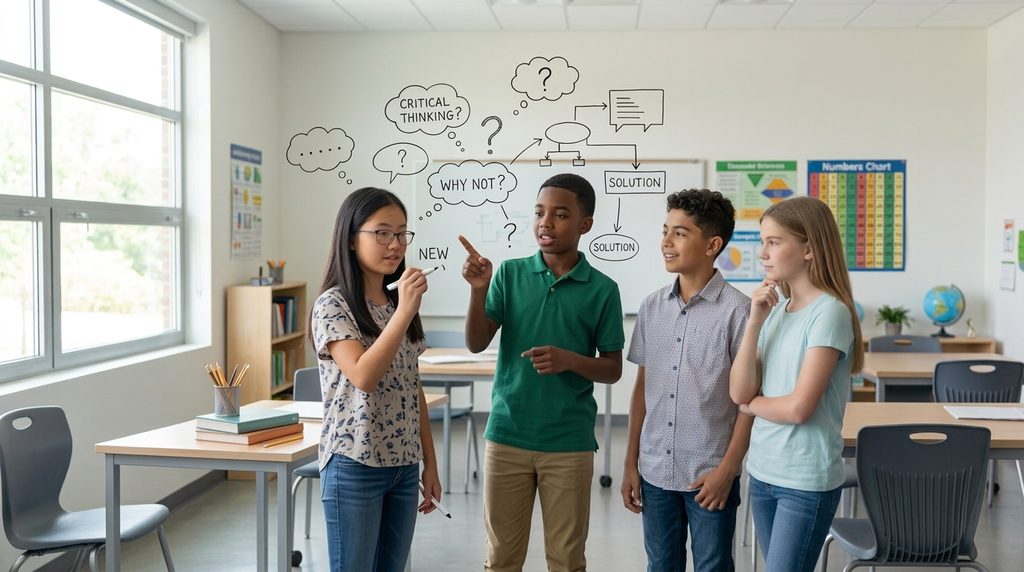
ATC21s organized 21st-century skills into ten skills across four categories: Ways of Thinking, Ways of Working, Tools for Working, and Ways of Living in the World.
“Ways of Thinking” encompasses three areas: creativity and innovation; critical thinking, problem-solving, and decision-making; and learning to learn, or metacognition.
Creativity and innovation involve combining existing knowledge and ideas to generate new value. As AI increasingly takes over many routine tasks, the ability to imagine possibilities and create something that did not previously exist is becoming even more important.
Critical thinking involves asking questions such as, “Is this really true?” and “What evidence supports this claim?” In an age of misinformation and unreliable online content, it enables individuals to evaluate the evidence and credibility behind information before reaching a conclusion. Metacognition, meanwhile, is the ability to step back and observe one’s own thinking process. It allows learners to recognize where they went wrong, consider how they might approach learning differently, and continually improve. This lies at the heart of “learning how to learn.”
“Ways of Working” comprises two skills: communication and collaboration, or teamwork.
In the 21st-century workplace, cross-departmental projects and international collaboration across national borders have become increasingly common. The ability to express ideas clearly and work with people who hold different perspectives and values is therefore essential.
These competencies cannot be developed simply by reading textbooks. They grow through experience: engaging in dialogue, sharing responsibilities, navigating differences of opinion, and working with others to solve problems. Learning alongside peers from diverse cultural backgrounds offers valuable opportunities to practice these skills in everyday life.。
“Tools for Working” consists of two skills: information literacy and ICT literacy.
Information literacy is the ability to identify relevant information from an enormous volume of available material, evaluate its reliability, and use it responsibly and ethically. In an online environment filled with misinformation and claims of uncertain credibility, developing this ability from childhood has become increasingly important.
ICT literacy refers to the ability to use information and communication technologies effectively. It goes beyond basic computer operation and includes using technology as a tool for problem-solving.
“Ways of Living in the World” comprises three areas: local and global citizenship; life and career development; and personal and social responsibility, including cultural awareness and adaptability.
These areas may not immediately come to mind when we hear the word “skills.” However, they concern important questions such as: “How can I contribute as a member of my local community and the wider world?” and “How can I shape my own future while respecting different cultures and values?”
International schools, where students regularly interact with people of different nationalities, languages, and cultures, can provide particularly rich opportunities to develop this sense of global citizenship in a natural, everyday context.

In the years ahead, acquiring knowledge alone will not be enough. Children will also need to apply what they know to solve problems and adapt flexibly to change. This section explains why 21st-century skills have become a key focus in education worldwide.
As AI advances rapidly, routine administrative tasks, data entry, and repetitive manufacturing processes are increasingly being automated. At the same time, capabilities such as formulating new questions, communicating with others while understanding emotions and context, and working with people who hold different values to address complex social challenges are becoming increasingly important areas of human contribution.
Many of the competencies included within 21st-century skills are particularly valuable in an age of increasingly capable AI. They are skills that today’s children will need to continue developing throughout their lives.。
In an information-rich society, technologies and knowledge are continually updated. What students learn today may not remain directly applicable twenty years from now. Long-term value therefore lies not only in how much knowledge a person currently possesses, but also in the ability to acquire new knowledge independently and continue applying it in changing circumstances.
This is the essence of “learning to learn,” or metacognition, which ATC21s emphasizes. Learning how to learn provides a foundation for adapting to new knowledge, technologies, and environments as the world changes.
Inquiry-Based Learning, widely used in international schools, gives students opportunities to develop these habits: asking questions, conducting their own research, discussing ideas with peers, reflecting on what they have learned, and improving their approach.
21st-century skills are not a concept valued only outside Japan. They have also become an important theme in educational reform within Japan. This section looks at their relationship to Japanese education policy and how they differ from more traditional approaches to education.
In 2011, materials from the Ministry of Education, Culture, Sports, Science and Technology (MEXT) concerning the use of information technology in school education recorded support for equipping Japanese students with the 21st-century skills being discussed internationally in response to increasing globalization.
In 2013, the National Institute for Educational Policy Research (NIER) also presented its own framework of “21st-Century Competencies.” This framework was organized into three interconnected levels: foundational competencies, including the ability to use language, numbers, and information as tools; thinking competencies, including creativity, logical thinking, metacognition, and adaptive learning; and practical competencies, including career planning, communication, civic participation, and ethics. These developments reflect the growing recognition of such competencies within Japanese education.
Japanese school education has historically emphasized acquiring and consolidating knowledge. In recent years, however, greater attention has also been given to learning that develops critical thinking, self-expression, and collaboration, and educational approaches are continuing to evolve.
Developing 21st-century skills requires more opportunities for students to use what they know—to think, express ideas, and work with others. Discussions and group work, written and analytical assignments, and interactive learning supported by ICT can all contribute to this process.
Many international schools routinely incorporate discussion, debate, presentations, and project-based learning into everyday classroom practice. The question is not whether one educational system is simply “right” and another “wrong.” What matters is considering what we want children to develop and then choosing an educational environment that supports those goals.
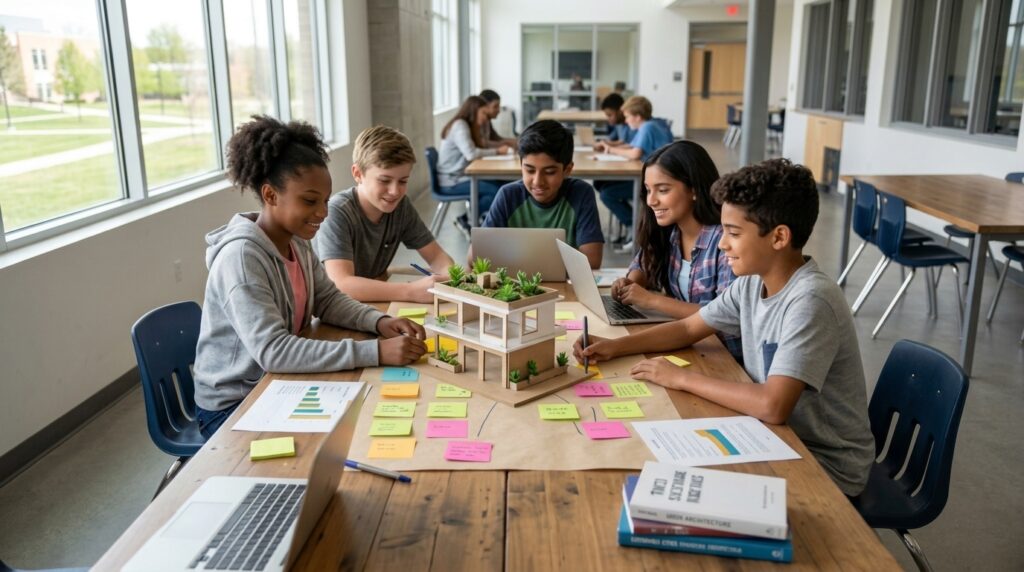
Developing 21st-century skills requires more than acquiring knowledge. Students also need regular opportunities to think, communicate, and collaborate in authentic learning situations. This section examines the relationship between 21st-century skills and the educational approaches commonly found in international schools.
Inquiry-Based Learning, widely adopted in international schools, is an educational approach that can develop multiple dimensions of 21st-century skills across Ways of Thinking, Ways of Working, information use, and citizenship.
Rather than having teachers simply provide answers, students are encouraged to formulate their own questions, investigate, discuss, and present their ideas. Through this cycle, they develop critical thinking, communication, information literacy, and collaboration through practical experience.
Dialogue with peers from diverse cultural backgrounds also gives students experience in approaching open-ended questions from multiple perspectives and creates opportunities to develop global citizenship.
As an authorized International Baccalaureate Primary Years Programme (IB PYP) school, Yoyogi International School provides an inquiry-driven learning environment designed to develop a broad range of competencies that closely align with 21st-century skills.
Small class sizes, in particular, make it easier to design learning experiences in which every student has opportunities to contribute and participate in dialogue. These everyday experiences of communication and collaboration provide an important foundation for developing two of the core 21st-century skills. An environment in which expressing one’s own ideas and listening thoughtfully to others’ perspectives are part of everyday learning also helps students develop greater agency as learners.
21st-century skills are the competencies identified through the ATC21s framework as necessary for navigating a rapidly changing world. They comprise ten skills across four categories—Ways of Thinking, Ways of Working, Tools for Working, and Ways of Living in the World—and include critical thinking, communication, information literacy, and global citizenship.
At a time when education must increasingly help children develop capabilities that enable meaningful human contribution in an AI-driven world, Inquiry-Based Learning, widely used in international schools, offers a powerful approach to cultivating 21st-century skills through everyday learning.

Yasuo Eguchi
MBA, Master of Computer Science
Yoyogi International School | General Manager of Technology and SEO Strategy
Head of Technology, experienced in digital transformation, web development, and content strategy. Writes about international schools and education.