
Bilingual education has attracted growing interest as an approach that enables children to develop and use two languages as part of their everyday learning and lives. Many parents hope their children will become proficient in both Japanese and English, yet it is equally natural to have questions: When is the right time to begin? What kind of language environment should be created at home? Can learning two languages place too much pressure on a child?
This article looks at the fundamental ideas behind bilingual education, its benefits and important considerations, and approaches that may be appropriate at different ages and in different environments. The aim should not simply be for a child to “speak English.” What matters is considering how a child can develop a meaningful relationship with both languages while respecting their stage of development and maintaining an appropriate balance with their home language.
Bilingual education refers to an approach in which two languages are used consistently in learning and everyday life, allowing language ability and broader learning to develop together. It differs from simply studying the vocabulary and grammar of a foreign language. Its distinctive value lies in giving children repeated opportunities to use language to think, understand, learn, and interact with others. This section considers its definition, historical background, and some of its principal approaches.
The term “bilingual” describes a person who uses two languages. It does not, however, necessarily mean that both languages are used at exactly the same level or with native-like proficiency. In practice, language ability may differ across speaking, listening, reading, and writing, as well as according to the context in which each language is used, such as at home, at school, or at work.
For this reason, bilingualism is difficult to define by a single fixed standard. It is often more useful to consider how, where, and to what extent a person uses two languages in real life.
According to research by Ritsumeikan University, bilingual education in the United States expanded alongside increasing immigration during the nineteenth century. As people with different linguistic backgrounds came to live within the same society, the question of how multiple languages should be addressed in children’s education became increasingly important.
Education was initially provided in some immigrant languages, but after the First World War, pressure for greater linguistic uniformity in English intensified and multilingual education declined for a period. As society later became more culturally diverse, the significance of linguistic and cultural diversity was reconsidered, and bilingual education developed in a variety of forms.
This history illustrates that bilingual education is more than a method of language instruction. It is also closely connected to the way societies understand linguistic and cultural diversity.
Growing interest in bilingual education reflects a world in which people and information move across national borders with increasing ease. As children are more likely to study, work, and collaborate with people from different linguistic and cultural backgrounds, the ability to understand another person’s perspective and communicate one’s own ideas appropriately has become increasingly important alongside language proficiency itself.
English is widely used in international contexts, and the ability to learn, access information, and communicate in English can broaden a child’s future options, including study abroad, higher education, and professional opportunities.
Exposure to two languages can also introduce children to differences in culture and ways of seeing the world, not merely differences in words. Interest in bilingual education is therefore closely connected to the hope that children will develop both linguistic ability and a deeper understanding of cultural diversity.
There are many approaches to bilingual education. Two widely discussed models are two-way immersion education and transitional bilingual education. (Source: “Trends in Bilingual Education in the United States,” Hisako Okuda, Hiroshima Shudo University.) The two approaches differ in the purpose for which the languages are used, the balance between them, and the language environment ultimately intended.
Two-way immersion education uses two languages consistently for subject learning, with the aim of developing proficiency in both.
The precise model varies from school to school. For example, a school may divide languages by subject or by time of day, teaching mathematics and science in English while other subjects are taught in Japanese. A central feature is that language is not treated solely as an academic subject; it is used as a genuine means of understanding content, thinking, and communicating.
In an environment where two languages are used as part of everyday learning, children can develop more than linguistic skills. They also gain experience communicating with people from different backgrounds and encountering a wider range of perspectives.
Transitional bilingual education uses a child’s stronger or home language as a foundation for learning while gradually increasing instruction through a second language.
In the early stages, the home language supports understanding of academic content. As proficiency in the second language develops, a greater proportion of learning takes place through that language. One advantage of this approach is that children can continue to draw on the knowledge and thinking skills they already possess while acquiring a new language.
When the eventual goal is to move predominantly into second-language instruction, however, deliberate support may also be needed to maintain literacy, vocabulary, and cultural connections in the home language.
Bilingual education is not something that takes place only in international schools. It can develop across a range of environments—in the family, at school, or through life abroad—where children have sustained opportunities to use two languages.
What matters is not simply that children “hear” two languages, but that they continue to use each language in meaningful situations. It is also important to consider the balance a particular child needs between the language used at home, the language of schooling, and the literacy skills that may be required later in life.
In families where parents have different home languages, children may be exposed naturally to two languages from an early age. Some families adopt the “one person, one language” (OPOL) approach, in which, for example, one parent speaks primarily Japanese and the other primarily English.
The presence of two languages in the home, however, does not automatically mean that both will develop equally. Development is influenced by who speaks which language with the child, how much time is spent using it, and whether the child has both a reason and a desire to use it. The most sustainable approach is one that fits the circumstances of the individual family and can be maintained naturally over time.
Living abroad or attending a local school can provide abundant opportunities to use a second language not only in lessons but also in friendships and everyday life. Language is therefore acquired as a genuine means of communication rather than solely as something studied in class.
For families planning to return to Japan, however, it is also important to maintain Japanese vocabulary and literacy. After returning, opportunities to use the second language may decrease considerably. Continued access to reading, learning, friendships, and other meaningful activities in that language can make an important difference in maintaining proficiency.
In recent years, more families have chosen preschools and international schools as environments in which children can use English as part of their daily education.
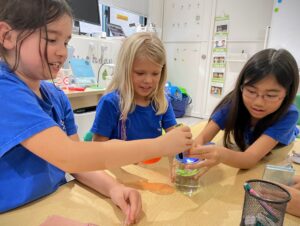
In these schools, English is not simply studied as a subject. Children use it to think, learn, and interact with teachers and friends throughout the day. The experience therefore moves from “learning English” towards “learning in English,” creating an environment in which practical language ability can develop through genuine use. Children who learn alongside classmates from a range of cultural and linguistic backgrounds also encounter different perspectives and customs as part of ordinary school life. When language learning is embedded in an international educational environment, children gain opportunities to learn about communication itself and about cultural difference.

The value of bilingual education extends beyond the ability to use two languages. Living with more than one language and encountering different cultures and perspectives can influence how children think, how they understand the world, and the possibilities available to them in future learning and life. Three important areas are considered below.
People who use two languages regularly must select and switch between languages according to the situation. This process engages cognitive functions associated with attention, inhibition, and mental flexibility. A substantial body of research has examined the relationship between bilingualism and cognition; however, findings vary according to factors such as age, proficiency, and patterns of language use. It would therefore be too simplistic to assume that bilingualism uniformly improves every aspect of cognitive ability.
Learning a language can also provide an entry point into the culture, society, and ways of thinking associated with it. Discovering that the same experience may be expressed or understood differently across languages and cultures can help children recognise that their own perspective is not the only possible one.
Over time, such experiences can encourage greater openness to people with different backgrounds and values, as well as the flexibility to consider an issue from more than one point of view.
The ability to use two languages can broaden future educational and professional possibilities. In particular, the capacity to access information, study, and communicate ideas in English can be highly valuable in international higher education and in workplaces where people of different nationalities collaborate.
Future opportunities, however, are not created by the simple fact of “speaking English.” The deeper value of bilingual education lies in what a person is able to learn through language, how they think, and how effectively they can work and communicate with others.

Bilingual education offers many possibilities, but it is not desirable to rush second-language acquisition without considering a child’s development and everyday environment. The two languages should not be treated as if they are competing with one another. Rather, families should consider the role each language plays in the child’s learning, relationships, and daily life, and support both from a long-term perspective.
It is extremely important to develop fully the language through which a child thinks, expresses emotions, and builds relationships within the family. For a child whose principal home language is Japanese, this means supporting not only everyday conversation but also age-appropriate vocabulary, literacy, and the ability to understand and express increasingly abstract ideas.
Even when a child spends substantial time in an English-speaking environment, there should still be opportunities to have rich conversations in Japanese, read books, and express ideas in the language. Supporting the home language is important for maintaining connections with family and culture, and it need not be seen as being in conflict with learning a second language.
In the past, the term “semilingualism” was sometimes used to describe a situation in which neither of a child’s two languages appeared to be developed to an age-appropriate level. Today, however, the term is often viewed critically because it can oversimplify children’s language abilities and frame them negatively. The more important question is whether a child is developing the language skills needed for learning and daily life in each of the languages they use.
Bilingual development is shaped by many factors, including the amount and context of language use, the educational environment, and opportunities for reading and writing. If a child experiences learning difficulties in either language, it is important not to attribute them simply to “being bilingual,” but to look carefully at the child’s language history and learning environment and seek appropriate support when needed.
It is not unusual for young bilingual children to use Japanese and English within the same conversation. This does not necessarily indicate confusion; in many cases, children are using the linguistic resources available to them flexibly at that stage of development.
“One person, one language” (OPOL) is one possible way for families to provide consistent exposure to two languages. For example, one parent may speak mainly English while the other speaks mainly Japanese. This can help ensure regular contact with each language, but it is not the right approach for every family. The priority should be natural, meaningful communication within the family and genuine opportunities for the child to use each language.
Even a language that has been well developed can gradually lose vocabulary and fluency when opportunities to use it decline substantially. Children’s language abilities are particularly responsive to their environment, and a return from overseas or a change of school can alter which language is used most frequently in everyday life.
To maintain proficiency, children need continuing opportunities to use the language after their environment changes. Reading, conversation, academic learning, and interaction with friends can all help. Meaningful use of a language within activities that matter to the child may support continuity more naturally than simply increasing formal study time.
Similarly, when a child whose home language is Japanese attends an international school, speaking Japanese at home is valuable, but so too are age-appropriate opportunities for reading and written expression as the child grows.

Approaches to bilingual education should not be determined by age alone. A child’s developmental stage, previous language experience, the languages used at home and at school, and the likely future educational environment all need to be considered together. The following sections outline some points to consider at different ages and in different circumstances.
During the early years, children are highly receptive to the sound patterns and structures of language through interaction with the people around them. When they are consistently exposed to two languages, they can begin to acquire both naturally as part of everyday life.
An educational setting such as a preschool or international school where English is used throughout the day can be one option. What matters, however, is not simply exposure to “native English,” but rich interaction with teachers and other children in which language has purpose, meaning, and enjoyment.
Children at this age are also particularly responsive to changes in their linguistic environment. Even when opportunities to use English are increased, continued engagement with Japanese or any other language valued within the family remains important.
From around ages six to eight, children increasingly use language not only for conversation but also for reading, writing, and academic learning. Being able to hold an everyday conversation is not the same as having the language needed to read texts, organise ideas, and understand increasingly complex subject matter.
At this stage, it is helpful to consider what the child is learning through each language and in which contexts. Rather than forcing an exclusive choice between Japanese and English, families can clarify the respective roles of the school language and the home language and ensure continued experience with literacy in both where appropriate. This provides a stronger foundation for stable language development.
The outcome of bilingual education is not determined by age or family background alone. It is influenced by how long and in what contexts a child uses each language, whether the child sees meaning in using it, and how the adults around them provide support.
A child may have lived overseas yet gradually lose some proficiency if opportunities to use the language largely disappear after returning home. Conversely, a child living in Japan can develop a high level of second-language proficiency when that language is used consistently through school, family life, friendships, or other meaningful settings.
Three elements are particularly important: an environment suited to the child, continuity that can be sustained over time, and motivation that gives the child a genuine reason to use the language. These should not be treated as a fixed formula; they need to be reconsidered as the child grows.

For bilingual education to be sustained in Japan, responsibility cannot rest solely with the school or solely with the family. It is important to consider where, with whom, and for what purpose a child uses each language, and to create a language environment that can be maintained across everyday life.
Children are more likely to continue learning a language when they experience it as meaningful and enjoyable rather than as something imposed upon them. For young children in particular, language is less something to be memorised at a desk than a means of connecting with people, playing, and discovering things that interest them.
Songs, picture books, games, stories, and everyday conversation can provide natural ways to engage with English according to a child’s interests. Positive experiences can reduce anxiety about the language and encourage a genuine desire to understand more and try using it. This kind of intrinsic interest can become an important foundation for long-term learning.
Families considering bilingual education do not necessarily need to begin with specialised materials. Reading English picture books, listening to songs, or enjoying a favourite programme in English can create natural points of contact with the language in everyday life.
Using a few simple English expressions at home does not need to become an objective in itself. More important is creating meaningful interaction in which a child understands what is being communicated and can share thoughts or feelings with another person. Rather than forcing themselves to speak only English, parents may communicate richly in the language in which they are most natural and confident while creating other high-quality opportunities for their child to encounter English.
Establishing some regularity can also help. Daily reading, a weekend film, or online conversation can become sustainable habits when they fit the family’s routine and the child’s interests.
Parents do not need perfect English. What children need is an environment in which they feel secure using language, are not afraid of making mistakes, and can enjoy communication.
In an international school, English is not simply a subject to be studied. It becomes an everyday language used to understand lessons, speak with friends, and express ideas. Because there is a genuine need to use English throughout the school day, children can connect what they learn in the classroom with real communication.
Learning alongside children of different nationalities and cultural backgrounds also gives students experience using language for something more important than simply “speaking correctly”: understanding people whose perspectives may differ from their own. This is one of the distinctive forms of learning that an international educational environment can provide and is difficult to reproduce through home study or short language lessons alone.
Attending an international school, however, does not automatically make a child bilingual. The stronger the English-language learning environment becomes, the more important it may be to consider how Japanese and other home languages will continue to develop. Families should therefore look at a school’s educational philosophy, language support, and partnership with families when deciding whether the environment is right for their child.

Parents considering bilingual education often ask when they should begin, whether two languages will confuse a child, and whether bilingual education is possible when the parents themselves do not speak English. The following are some of the most common questions.
Exposure to a second language in early childhood can make it easier for children to become familiar with its sounds and pronunciation. For this reason, many families introduce English naturally into everyday life from a young age.
The age at which a child begins, however, does not by itself determine future proficiency. The continuity and quality of exposure, opportunities for genuine use, and whether the child feels secure in the learning environment are equally important. At any age, the emphasis should be on an approach that suits the child’s development and interests and can be sustained without unnecessary pressure.
Learning two languages at the same time does not in itself necessarily confuse children. Young bilingual children may use Japanese and English within the same conversation, but this can be a natural part of bilingual development rather than evidence of confusion.
The amount of exposure to each language and the contexts in which it is used will naturally differ. If Japanese is the main language at home, families can support rich conversation and, as the child grows, reading and writing in Japanese while also ensuring regular opportunities to use English. The goal is to create an environment in which both languages can continue to develop.
Parents do not need to be fluent in English to create opportunities for their child to encounter and learn the language. In fact, rich communication in the language parents use most naturally is itself important for a child’s language and cognitive development.
English exposure can be provided through picture books, audio, video, online interaction, and educational settings where English is used meaningfully. Rather than forcing themselves to communicate only in an unfamiliar language, parents can focus on creating consistent, high-quality contact with English in ways that suit the family.
What children need from their parents is not perfect English, but interest in their learning and support for an environment that can be sustained over time.
It is entirely possible for children living in Japan to develop a high level of proficiency in two languages. When there is little practical need to use the second language in daily life, however, opportunities for meaningful use need to be created deliberately. International schools and preschools, online interaction, reading, and extracurricular activities now provide a wide range of ways to use English while living in Japan. More important than simply increasing the number of lessons or materials is whether a child has sustained opportunities to think, understand, and interact with others through English.

Bilingual education is not simply about acquiring two languages. Through different languages, children can connect with people, learn, and encounter different ways of seeing the world. At the same time, it is important not to rush the process or to prioritise English at the expense of the child’s broader language development. A long-term view that includes the home language is essential.
Families and schools each offer different forms of support. An international school can provide an environment in which children do not merely “study English,” but use English every day to learn, think, and build relationships with friends. Yet the English-language environment alone should never be the sole criterion when choosing a school. Its educational philosophy, teachers, curriculum, support for individual children, and partnership with families all matter when considering which educational environment will best serve a particular child.
Yuko Muir
Doctor in International Psychology
Yoyogi International School | Founder and CEO
Founder and CEO of Yoyogi International School with over 27 years of experience in school leadership. Holds a Ph.D. in International Psychology and draws on extensive practical and academic background to explore key issues in education.