




As interest in global education grows, an increasing number of families are considering international schools. However, many parents find themselves unsure of the best age to enroll their child. The experiences gained and the skills developed can vary significantly depending on the age of entry.
This article clarifies the typical age ranges for international schools and provides an easy-to-understand explanation of the best timing, along with the pros and cons of different age groups. The article will also cover the typical age until which a student can remain enrolled. Use this guide to help determine the best path for your child.
Generally, children can enter international schools starting around age 5. However, many preschools accept children as young as 2. Enrollment ages and grade cut-offs vary by school and differ from the standards of Japanese kindergartens and elementary schools, so it is important to check these details in advance.
Here, it is explained the possible enrollment periods by age, the criteria for judgment, and the grade systems used by different curricula.
In many cases, international schools accept students from age 5. There are also institutions called preschools or nurseries, which more families are choosing as alternatives to local daycares or kindergartens.
Typically, the categories are:
Around age 6, students progress to Elementary School, which corresponds to the Japanese elementary school curriculum. Many schools offer continuous education through middle and high school, and it is common for families to plan their child’s education with a long-term perspective.
Entry grade at an international school is not decided simply by birthday. The first important factor is the Cut-off Date. Most schools divide grades based on an August or September deadline.
Next, assessments of English proficiency and academic ability are conducted; a certain level of comprehension and expression may be required. Furthermore, for non-Japanese families, visas and residency status are also verified. Entry grade is determined by a comprehensive judgment based on these three criteria.
The grade system of an international school varies depending on the curriculum it adopts.
For example, the International Baccalaureate (IB) is characterized by three stages: Primary Years Programme, Middle Years Programme, and Diploma Programme. The American curriculum follows a “Grade” system starting from Kindergarten. The British curriculum uses a “Year” system, which counts grades differently.
The differences among these systems are summarized in the table below. The color coding in the table corresponds to the equivalent stages of elementary school, junior high school, and high school in Japan.
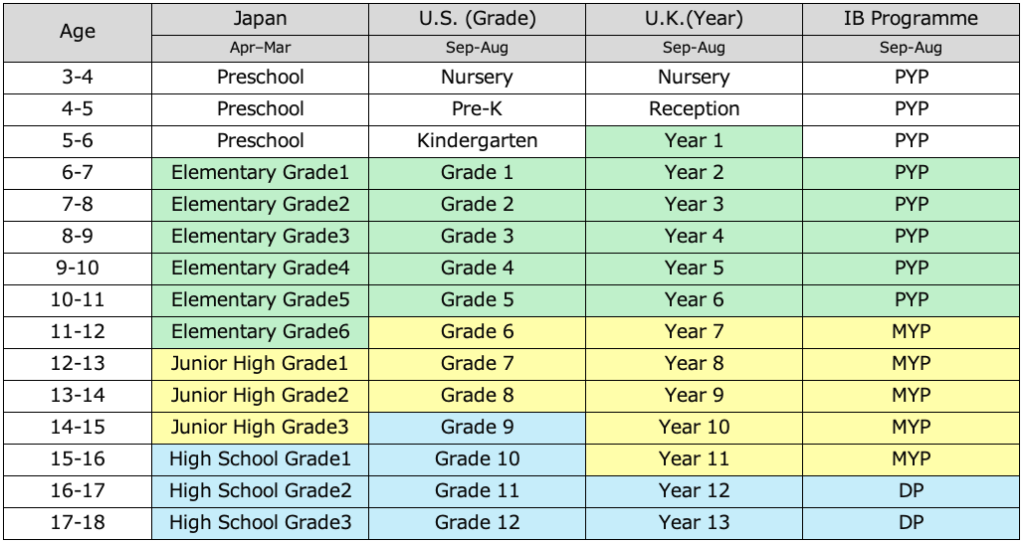
Since many schools do not align with the Japanese School’s April start, there may be a gap between a child’s age and their grade level. Therefore, it is important to understand the specific system of your target school when considering the timing of enrollment.

The suitability of enrollment timing depends on the child’s developmental stage. While early enrollment offers significant benefits, it also presents challenges that require attention. It is important to understand the characteristics of each age group and consider options that align with your family’s educational philosophy.
The ages of 2 to 3 are a critical period for rapid linguistic and sensory development. Entering an English environment at this stage makes it easier to form a foundation for pronunciation and listening skills.
A major advantage of entering at age 2 is placing the child in an English environment during the “critical period” for language acquisition. Exposure to English sounds while the ears are flexible allows for the natural acquisition of pronunciation and intonation.
Furthermore, children can absorb English as a “living language” rather than a subject of study. Since they learn English expressions through daily play and activities, they are less likely to develop a resistance to the language. Thus, exposure to diversity from early childhood builds a foundation for flexible thinking.
Conversely, this is an age where Japanese development can easily be delayed. If a child is placed in an English-centered environment before their mother tongue vocabulary and expression are sufficiently developed, their linguistic balance may become unstable.
Caution is especially needed if Japanese conversation is limited at home. Ongoing efforts, such as consciously increasing reading time and dialogue in Japanese, will be required. Additionally, early childhood is an important time for parent-child bonding; a long-term childcare environment may place a burden on the child. It is essential to monitor the child’s overall mental and physical development, rather than focusing solely on educational effects.
As this coincides with the start of Japanese elementary school, it is an age where many families struggle with the choice of path. However, at this stage, children have already acquired a certain level of basic Japanese and social habits, making them relatively adaptable to a new learning environment. This is often the most realistic option for families considering a transfer to an international school.
The biggest advantage of entering in lower elementary school is that the foundation of the Japanese language is already established. As vocabulary and reading skills have grown, it is easier to proceed with English learning while maintaining Japanese identity and thinking skills.
Additionally, as the mother tongue is stable, switching between English and Japanese tends to go relatively smoothly. As they are already used to school rules and group behavior, they tend to adapt to the new environment quickly. In terms of academics, this is when conceptual understanding of math and science begins, which can lead to experiences that foster logical thinking through English. Parents may also feel relieved that there is less need for excessive reinforcement of Japanese at home.
On the other hand, when entering an English environment at this age, language acquisition requires a certain amount of time. Since classes proceed in English, it is common for children to initially feel anxious due to a lack of understanding of teacher instructions or materials. Especially when literacy-based learning begins, a lack of English proficiency can lead to a delay in overall learning.
Furthermore, follow-up at home and support from the school are vital. Rather than seeking immediate results, support the child both academically and psychologically while monitoring their gradual growth.
By age 9, reading comprehension and logical thinking in Japanese grow significantly. When transferring to an international school at this stage, it tends to be more about a “shift in learning environment” rather than just language acquisition. This is an age where more families consider it as a choice looking toward future career paths and higher education.
A characteristic of transferring in the upper grades is that thinking skills and basic academic ability in Japanese are fully developed. Since abstract concepts in math and science are understood in the mother tongue, the transition to understanding that content in English will be smoother.
Study habits and self-management skills are also beginning to grow, allowing students to engage proactively in assignments and presentations. For families eyeing future university admission abroad, there is the advantage of early exposure to academic English. The ability to build English skills while maintaining Japanese proficiency is a significant point of reassurance.
The flexibility for language acquisition tends to be lower than in early childhood, and the stage of unconsciously absorbing English as a living language has passed. Therefore, it is important to learn grammar and vocabulary consciously.
Additionally, as this coincides with the onset of puberty, changes in the environment can lead to a psychological burden. As there may be anxiety regarding building friendships or self-expression, a support system for mental well-being (not just academics) should be established.

When deciding when to enroll in an international school, it is not appropriate to judge based on age alone. A multi-faceted perspective is required, including the child’s development, the family environment, and future educational goals. Here, this article covers three points of particular importance.
The most important factor is the compatibility between the family’s educational philosophy and the child’s personality. The choice will change depending on whether you aim for an overseas university or a Japanese university in the future. While some families prioritize English acquisition, others value the stability of the mother tongue. It is important to respect the child’s own will and aptitude, rather than making decisions based solely on the parents’ educational philosophy.
Tuition for international schools generally ranges from 1.5 million to 3 million yen per year. Additionally, enrollment fees, facility fees, and materials fees are often required. School bus fees, lunch fees, and extracurricular activity fees may also be necessary. If long-term attendance is planned, the total cost will be substantial. Therefore, it is important to have a stable financial plan and a view of the entire household budget, including plans for siblings.
When attending an international school, Japanese education at home is indispensable because school life will be centered on English. Especially for those who enroll at a young age, conscious reinforcement is required. In addition to daily conversation, habits of reading and writing are important. Do not look only at English improvement; monitor the growth of the mother tongue simultaneously.

Entering an international school involves multiple screening criteria beyond age. Requirements vary by school, and preparation can often determine the outcome.
International schools may check English proficiency and academic ability before admission. In the early years, this focuses on simple interviews and behavioral observation. From elementary school onward, reading and writing exams may be required. Standards vary greatly by school, so carefully check the application guidelines of your target school and prepare accordingly.
Each international school has its own admission policy. Some schools prioritize a specific balance of nationalities, while others have a broad policy of accepting diversity. Many schools emphasize parent interviews to confirm that the family’s educational philosophy aligns with the school’s mission.
These differences in policy directly relate to the school culture, so attend briefings or tours to deepen your understanding before applying.

International schools employ unique systems that differ from the Japanese grade system. The age of entry and the age at which one completes the curriculum depend on the system used, such as American, British, or International Baccalaureate (IB).
In American-style international schools, education begins at age 4 (Kindergarten) and ends at age 18 with the completion of Grade 12. While many schools offer Pre-K (age 4), compulsory education runs from Grade 1 through Grade 12 (it depends on states though). Typically, students in Grades 11–12 take college-level courses such as “AP (Advanced Placement)” to prepare for university, graduating at 18 with qualifications for international higher education.
In British-style international schools, education begins at age 4 or 5 (Foundation Stage) and concludes at age 18 with Year 13. A key feature is taking the “GCSE” (secondary education exams) at ages 14–16 (Years 10–11), followed by the “A-Level” university preparation course during the final two years (Years 12–13). Completing Year 13 provides a widely recognized university entrance qualification.
Schools adopting the IB program offer three stages of programs, providing education up to age 18.
The final “DP” stage is a crucial period for obtaining internationally recognized university entrance qualifications. By completing this program, students gain access to universities in over 160 countries and regions worldwide.
While many international schools allow entry from age 5 (and preschools from age 2) the optimal timing depends on family policy and the child’s characteristics. It is important not to judge by age alone, but to consider the path from a long-term perspective.